

A Toot from the Bag?
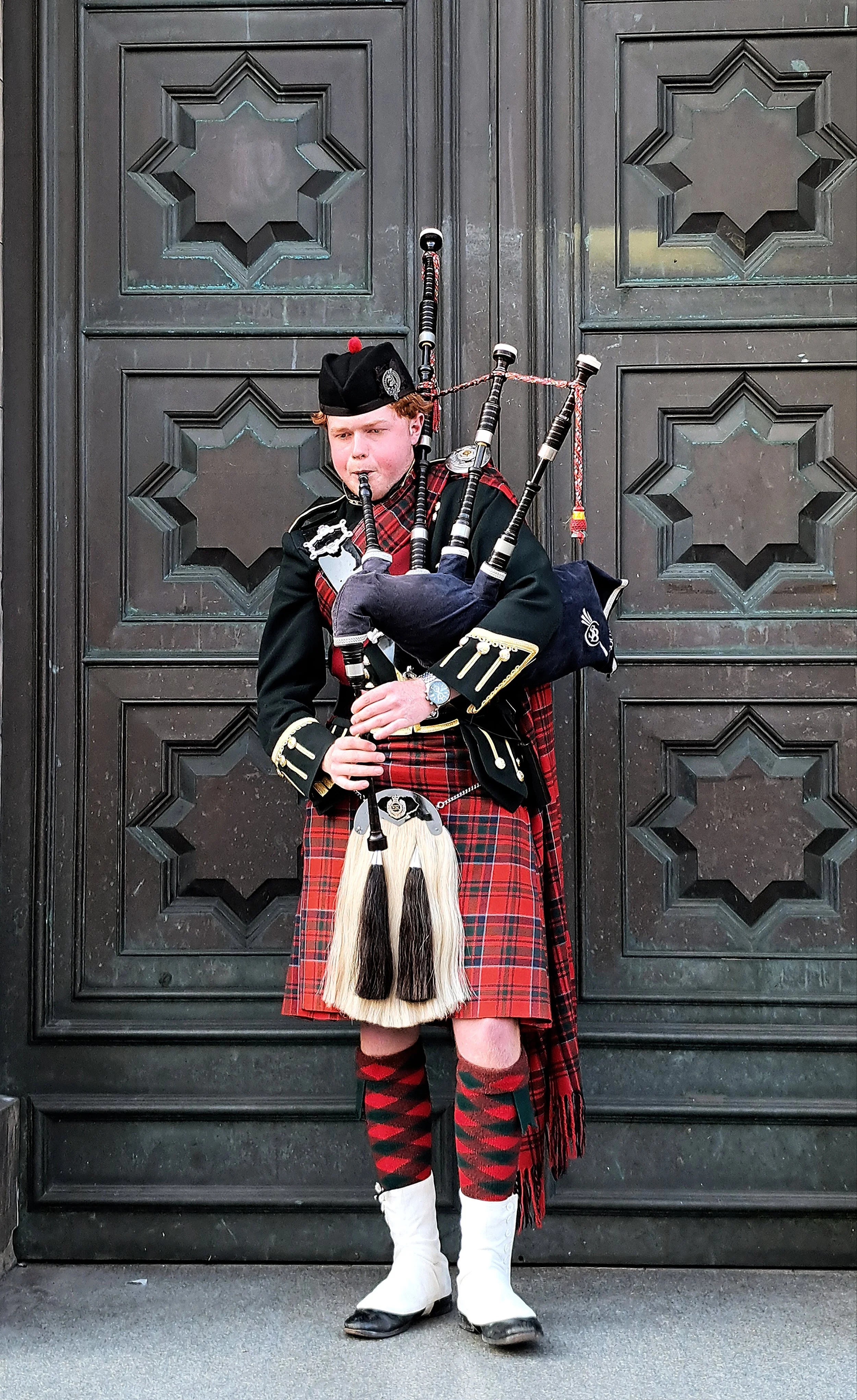
The bagpipes really do divide opinion. Some people hate the sounds that seem to be squeezed out of the instrument with enormous effort by people with red, puffed-up cheeks.
Others – and I’m definitely one of them – love their distinctive sound. So ancient and elemental that you can almost see the Highland clans before you, dressed in their tartan kilts, charging towards one another between green hills and deep, dark lochs – the Scottish lakes scattered across the landscape.
Or charging towards English soldiers.
I picture red curls bouncing up and down in cosy pubs or village halls at ceilidhs as people whirl through traditional dances together at dizzying speed. From tiny nappy-wearing toddlers to elderly dancers with walking sticks, with teenagers and everyone else in between.
The moment I hear bagpipes, I’m transported straight back to a cliff in the north of Scotland, where little puffins flap frantically as they try to stay airborne. Or peer curiously at you with those adorable eyes that look as though someone carefully applied their make-up. Like chubby bumblebees, they too are small, round miracles of nature.
With the sound of the pipes, I can smell foaming waves crashing against enormous rocks and something that smells like untamed freedom. Long valleys stretching between green hills – green everywhere, in every imaginable shade. Who knew there could be so many kinds of green?
And against all that green, the deep blue sky looks even more spectacular.
In German, the bagpipe has the rather unattractive name Sackpfeife – literally “bag pipe”. The translation we usually use would be Tooting bag in English and it somehow sounds much more cheerful – but the instrument itself actually has its origins in the Middle East and the eastern Mediterranean. Someone put a pipe into a leather bag, and suddenly that pipe sounded entirely different: intense, loud, sometimes furious, sometimes mournful.
The Romans probably brought the instrument to Europe, where it spread rapidly during the Middle Ages. Or perhaps, at least in the north, the Vikings once again had their big hands in the story, as they so often did. Nobody knows for certain.
Gradually, the role of the bagpipes changed. They became a Scottish national symbol. Where other armies used horns or drums to intimidate the enemy and bolster their own courage, the sound of the bagpipes became a battle cry – a way of summoning every last reserve of strength, pride and identity.
Imagine you’re an English soldier in the Scottish Highlands, already exhausted by the wind and weather, when suddenly the piercing song of the bagpipes cuts through the cool air.
And then you see them.
Tall, powerfully built, colourful tartans artfully draped around their waists and across their shoulders, their painted faces reflecting all the desperate fury of people facing the destruction of their families and culture.
Ready for anything.
Ready to fight until they drop.
My heart would sink straight into my boots. I’d probably have joined them instead – or run away as fast as my legs could carry me.
And after the defeat at the Battle of Culloden in 1746, the Highland way of life was indeed banned for a time as part of the British government’s efforts to suppress the Highland clan system and culture, called the “Highland Clearings”. Fortunately, we can see very clearly today that Scottish identity survived and even thrives.
Like karma hitting hard on the English, quite the opposite came true: Scottish regiments are now an integral part of the British Army, pipers very much included, and the Royal Edinburgh Military Tattoo has become one of Britain’s great annual spectacles.
And, incidentally, tattoo here has nothing to do with ink on skin. The name refers to a military tradition; today the Tattoo is a spectacular celebration of military music and performance held at Edinburgh Castle.
So the next time you hear the sound of bagpipes, think of the courageous Scots who stood against much larger armies with little more than determination, pride and their culture.
